
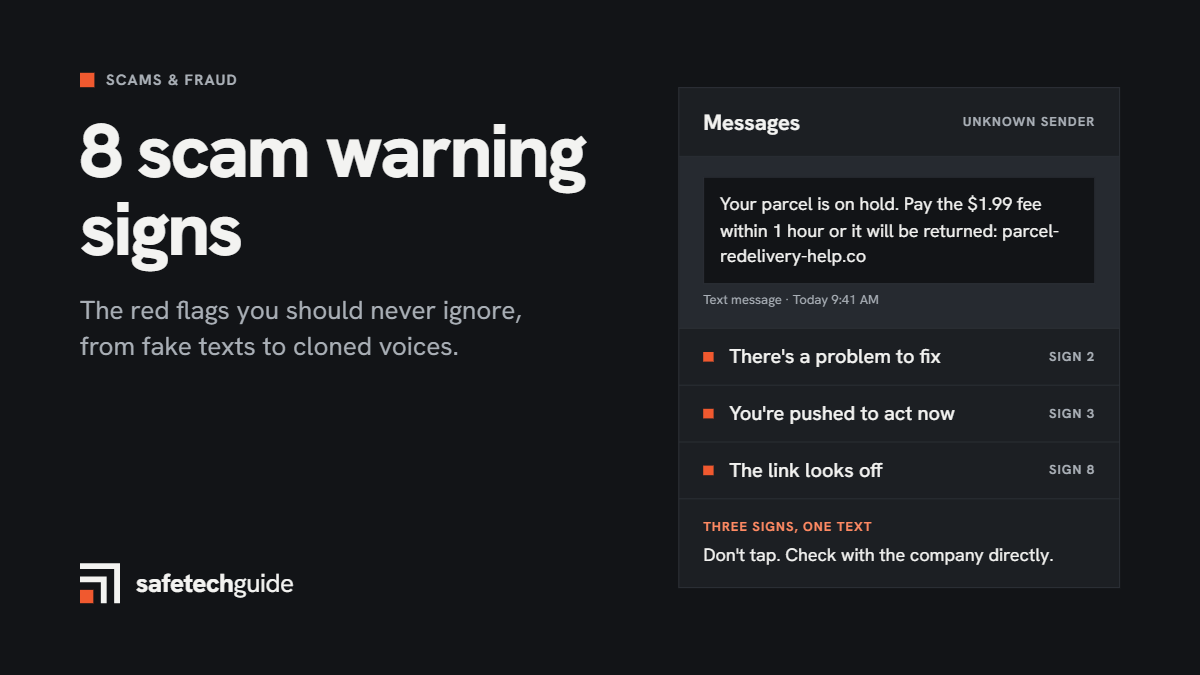

Most scams, whether they arrive by email, text, phone call, or social media message, share a few warning signs: someone contacts you unexpectedly, claims to be an organization you trust, tells you there’s a problem or a prize, pushes you to act now, and insists you pay in a way that’s hard to reverse. Others ask for codes or passwords, discourage you from checking, or play on your emotions. If you see even one, stop, don’t pay or share anything, and verify using a phone number or website you look up yourself.
Scammers change their methods constantly, from fake delivery texts to cloned voices, but the underlying pattern barely moves. This guide covers eight signs that hold across any channel, with the data behind why they matter and what to do if you spot them.
What the Numbers Show
The FBI’s 2025 Internet Crime Report, announced in April 2026, found that cyber-enabled crimes cost Americans nearly $21 billion. Americans over 60 reported about $7.7 billion in losses, up 37% from 2024. The FBI’s advice is to “take a beat,” resist pressure to act quickly, and assess the situation before turning over money or personal information. FBI, “Cryptocurrency and AI Scams Bilk Americans of Billions” (April 2026).
The FTC’s numbers point the same way. Imposter scams were the top reported scam for the ninth year in a row in 2025, with more than 1 million reports and reported losses of $3.5 billion. FTC, “New trends in reports of imposter scams” (May 2026). These are reported figures; the FTC and FBI both note that many scams go unreported.
None of these scams succeeded because the victim was careless. They succeeded because the scammer made it hard to stop and think. That’s why the signs below are mostly about pressure and process, not about spotting a typo.
The 8 Warning Signs
1. Someone contacts you unexpectedly and pretends to be someone you know
The FTC lists impersonation as the first sign of a scam: scammers pose as a government agency, utility, tech company, charity, or someone you know. Caller ID can be spoofed, so the name and number you see may be fake. An unexpected contact isn’t proof of a scam, but it’s a reason to verify before you respond.
2. There’s a problem, or a prize
The FTC says scammers claim you’re in trouble, owe money, have a family emergency, or have a computer virus. Or they say you won a lottery or sweepstakes but must pay a fee to collect. If you didn’t enter a contest or open the account, ignore the claim.
3. You’re pushed to act right now
According to the FTC, scammers rush you, may tell you not to hang up, and may threaten arrest, lawsuits, license loss, or deportation. Legitimate businesses give you time to decide. Anyone pushing you to pay or share personal data quickly is a scammer, in the FTC’s words.
4. They insist on a specific payment method
The FTC says scammers insist on cryptocurrency, wire transfers, payment apps, or gift cards, where you read out the numbers on the back. They may also send a check, tell you to deposit it, and ask you to send money back. The FTC’s July 2026 alert says people reported their largest losses, more than $4 billion in total, to scams where they paid by bank transfer or cryptocurrency, and advises paying by credit card when possible because it offers more protections. FTC, “A way to spot scams: how someone asks you to pay” (July 2026).
5. They ask for personal information or verification codes
The FTC says, “Don’t give your personal or financial information in response to a request that you didn’t expect,” and that honest organizations won’t ask for Social Security, bank, or card numbers by call, email, or text. Treat one-time codes the same way. A code is a key to your account; no legitimate caller or support agent needs you to read it out. (The FTC page doesn’t mention codes, so that last point is our advice. See our two-factor authentication guide.)
6. They discourage you from checking
Scammers want you isolated. They may tell you not to hang up or to keep it secret. The FTC’s advice is the opposite: contact the company through a site you trust or a number you look up yourself, and talk to someone you trust, because describing the situation to a friend, family member, or neighbor can help you recognize a scam. The FTC adds that it will never threaten you, demand you move money to “protect” it, or tell you to withdraw cash or buy gold. In our view, an organization that tries to stop you from checking is waving a red flag, since legitimate ones have nothing to lose from a call back.
7. It plays on emotion: fear, love, or greed
Threats, fake emergencies, romance, and promised returns all aim at your feelings. The FTC’s April 2026 data spotlight reports that nearly 60% of romance scam losses in 2025 started on social media and that investment scams caused the largest social media losses, $1.1 billion; see our guide to securing your social media accounts. Cloned voices add a new twist to the fear version; see our guide to AI voice cloning scams.
8. The links, sites, or profiles look off
Messages that contain links you didn’t expect are a common route. The FTC says not to click links in unexpected messages, even if they seem real. Look for a mismatched address, a brand-new profile, missing contact details, or a page that exists only to collect your details. Our guide to spotting a phishing email covers email in detail, and text scams covers messages.
Sources for signs 1 to 6 and 8: FTC, “How To Avoid a Scam” (July 2023; page updated August 2026).
What to Do If You Spot a Sign
- Stop. Don’t reply, click, or send money or information.
- Verify independently. Contact the organization using a number or website you look up yourself, not the one in the message. The FTC also suggests searching the company or person’s name with terms like “review,” “scam,” or “complaint.”
- Talk to someone. Tell a friend or family member before you decide.
- Block and delete. Use call-blocking and text-filtering tools, as the FTC suggests.
- Report it. File at ReportFraud.ftc.gov, even if you didn’t lose money. The FBI asks victims to report to ic3.gov.
If You’ve Already Paid or Shared Something
The FTC says to contact the company you used to pay right away, report the fraud, and ask whether the transaction can be stopped or reversed. Our guide to what to do if you fall for an online scam covers the steps by payment method, and the blackmail guide covers threats. Secure your accounts too: change passwords, turn on two-factor authenticationTwo-Factor Authentication Login security requiring two forms of verification, such as a password plus a code. It’s the most common form of multi-factor authentication., and review account activity. For the psychology behind why smart people fall for these, see social engineering.
At work? The same signs show up in scams aimed at businesses. See 6 holiday scams targeting small offices for the versions hitting workplaces this season.
People Also Ask
The sources we reviewed don’t rank the signs. The FTC lists four core ones: impersonation, a problem or prize, pressure to act now, and a demand for a specific payment method.
Yes. Scammers target emotions and timing, not intelligence. Pressure and a convincing impersonation can catch anyone.
The FBI and FTC both warn that scammers use AI, including cloned voices and fake images. We found no figure for how fast AI-assisted scams are growing. See our guides to AI voice cloning and AI-generated fakes.
Pause, then verify through a number or website you look up yourself. Search the name with “scam” or “complaint,” as the FTC suggests, and talk to someone you trust.
No. The FTC says caller ID can be spoofed, so the name and number you see may be fake.
Cryptocurrency, wire transfers, payment apps, and gift cards, according to the FTC, along with any request to deposit a check and send money back.
Sources: Federal Bureau of Investigation, “Cryptocurrency and AI Scams Bilk Americans of Billions” (April 2026); Federal Trade Commission, “New trends in reports of imposter scams” (May 2026); Federal Trade Commission, “A way to spot scams: how someone asks you to pay” (July 2026); Federal Trade Commission, “How To Avoid a Scam” (July 2023; updated August 2026); Federal Trade Commission, “Reported losses to scams on social media eight times higher than in 2020” (April 2026)
Leave a Reply
You must be logged in to post a comment.