
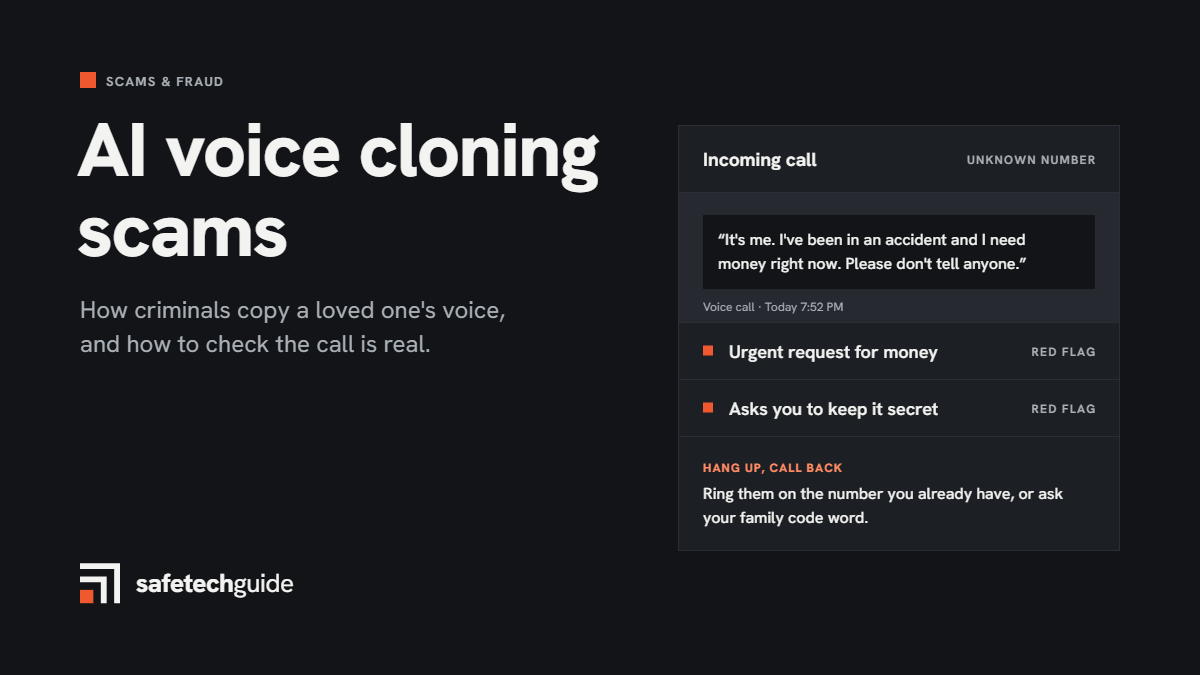

AI voice cloning scams use software to make a voice on the phone sound like someone you know, then use it to ask for urgent money or information. A convincing voice isn’t proof of identity. If a call asks for money, hang up and call the person back on a number you already have, contact another relative or friend, and refuse to pay by wire transfer, cryptocurrency, payment app, or gift card. Pressure, secrecy, and urgency are the warning signs, whether or not the voice sounds right.
Impersonation scams are the most reported kind in the United States, and AI makes the oldest version, the panicked call from a “relative,” harder to dismiss. This guide covers what the data shows, how these calls work, what to do during one, and how to reduce your exposure. For fake images and video, see our guide to identifying AI-generated fakes, which also covers family code words in more depth.
A Real Example: The Data and the Law
The FTC reports that imposter scams were the top reported scam for the ninth year in a row, drawing more than 1 million reports in 2025. Reported losses rose nearly 20% to $3.5 billion. That figure covers all imposter scams, not just those using cloned voices; the FTC’s summary doesn’t say how many involved AI. Source: FTC Consumer Alert, “New trends in reports of imposter scams” (May 2026).
Regulators have also acted on AI voices directly. On February 8, 2024, the Federal Communications Commission unanimously ruled that calls made with AI-generated voices are “artificial” under the Telephone Consumer Protection Act, making the use of AI voices in robocalls illegal in itself, not only the fraud the call is meant to carry out. The ruling also gave state attorneys general new tools to go after robocall operators. FCC, “FCC Makes AI-Generated Voices in Robocalls Illegal” (February 2024).
That ruling concerns automated robocalls. A scammer who phones one person and imitates their grandchild is committing fraud whatever the rule says, and a law doesn’t stop the call from reaching you. What helps is a habit of checking before you pay.
How These Scams Work
The FTC describes it this way: scammers use AI voice cloning to make their requests for money or information more believable. In its example, a caller claims to be a grandson who wrecked a car and was jailed, and the voice “sounds just like him,” which is why the victim may doubt the scam is real. Source: FTC, “Scammers use AI to enhance their family emergency schemes” (March 2023).
The FBI lists audio examples in its December 2024 warning about AI-assisted fraud: short clips of a loved one’s voice used to make a call sound like an emergency, and AI-generated audio used to impersonate someone to reach bank accounts. Source: FBI IC3, “Criminals Use Generative Artificial Intelligence to Facilitate Financial Fraud” (December 2024).
Where the audio comes from isn’t spelled out in the sources we reviewed. Voices posted on social media, in videos, or on voicemail greetings are plausible raw material, which is why the FBI advises limiting online content of your image or voice. How much audio a scammer needs is not something we can state; the original version of this post said under a minute might be enough, and we found no authoritative figure.
Common Versions
- Family emergency. The FTC says scammers contact you pretending to be a relative or close friend in trouble who needs money. The caller may claim an accident, arrest, or injury.
- Grandparent scams. The FTC example above is this version, with an older relative targeted by a caller posing as a grandchild.
- Impersonating an official or company. The FBI’s alert describes criminals using AI audio to impersonate people to reach bank accounts and video chats with supposed executives. If a call claims to be your bank, hang up and call the number on your card.
- Re-targeting. The FBI’s July 2026 alert describes scammers going after people who were already scammed. See our AI fakes guide for the details.
For text and phone variants without cloned voices, see our guides to text scams and vishing.
Warning Signs
The FTC’s red flags for family emergency calls:
- An urgent request for money from a family member or friend
- A voice that sounds like your relative (cloned voices can be convincing)
- A demand to wire money or buy gift cards. The FTC says a real loved one won’t pressure you to do either, “but a scammer might.”
From the FTC’s fake-emergency article and common scam patterns, also watch for requests to keep it secret and refusal to let you call back. Secrecy requests are a pattern the FTC addresses by telling you to contact another relative or friend even when the caller asked you not to.
What to Do During the Call
The FTC’s steps, from its article on fake emergencies:
- Slow down and resist the pressure to send money right away. You can hang up, or tell the caller you’ll call back. If hanging up feels uncomfortable, ask a question only the real person could answer.
- Call the person back on a number you know is right and ask whether they’re really in trouble.
- Check with other people, such as another relative or friend, even if the caller asked you to keep it secret.
Source: FTC, “Scammers Use Fake Emergencies To Steal Your Money” (updated August 2026).
A family code word is another check. The FBI recommends one, and our AI fakes guide explains how to choose it. Don’t depend on it alone: someone under stress may forget it, and a caller who doesn’t know it can claim they’re too scared to remember. Callback verification still works when the word doesn’t.
How Scammers Ask You to Pay
The FTC says scammers insist on payment that makes money hard to recover: wiring money through a company like Western Union or MoneyGram, sending cryptocurrency, using a payment app, or buying gift cards and reading out the numbers. Any of these in the middle of an emergency call is a reason to stop.
If You Already Paid
The FTC says “the sooner you act, the better.” Contact your bank or the payment company immediately, report the scam to the FTC at ReportFraud.ftc.gov and to your state attorney general, and file a complaint at ic3.gov. Our guide to what to do if you fall for an online scam has the steps by payment method.
Reducing Your Exposure
These steps are mostly our advice, with the FBI’s exposure advice as the exception:
- Limit voice and video you post publicly. The FBI advises limiting online content of your image or voice. Review who can see your posts; see how to secure your social media accounts.
- Let unknown numbers go to voicemail if you’re worried about being rushed. You can call back after you’ve had time to think.
- Don’t use voice as your only proof of identity. A voice can be imitated, so use an app, a passkeyPasskeys A passwordless login method that uses your device (like a phone or laptop) to securely verify your identity., or two-factor authenticationTwo-Factor Authentication Login security requiring two forms of verification, such as a password plus a code. It’s the most common form of multi-factor authentication. for important accounts. See our two-factor authentication guide.
- For small businesses, require a second approval or a callback to a known number before any payment or data request made by phone, even if the voice sounds like the owner.
- Talk to older relatives about the scenario before it happens. Knowing the script makes it easier to hang up. See 8 scam warning signs you should never ignore.
At work? Cloned voices are also used to fake a boss asking staff for gift cards or urgent payments. See 6 holiday scams targeting small offices.
People Also Ask
The FTC and FBI both warn that scammers use AI to clone voices and make calls more convincing. How good a given clone sounds varies, and we can’t say how much audio is needed.
We found no figure for cloned-voice scams specifically. The FTC reports that imposter scams overall drew more than 1 million reports and $3.5 billion in reported losses in 2025.
The FCC ruled in February 2024 that calls made with AI-generated voices are “artificial” under the Telephone Consumer Protection Act, so using them in robocalls is illegal in itself. We’re not lawyers, so check the rules for other situations.
Resist the pressure, hang up, and call your child on a number you know. Contact another relative or friend too, as the FTC advises.
It’s a good extra check, as the FBI suggests. Pair it with calling back on a known number, because a rattled person can forget a word and a scammer can try to talk around it.
Report it to the FTC at ReportFraud.ftc.gov, your state attorney general, and the FBI’s IC3 at ic3.gov, and contact your bank or payment company right away if you sent money.
Sources: Federal Trade Commission, “New trends in reports of imposter scams” (May 2026); Federal Communications Commission, “FCC Makes AI-Generated Voices in Robocalls Illegal” (February 2024); Federal Trade Commission, “Scammers use AI to enhance their family emergency schemes” (March 2023); Federal Trade Commission, “Scammers Use Fake Emergencies To Steal Your Money” (updated August 2026); FBI Internet Crime Complaint Center, “Criminals Use Generative Artificial Intelligence to Facilitate Financial Fraud” (December 2024)
Leave a Reply
You must be logged in to post a comment.