
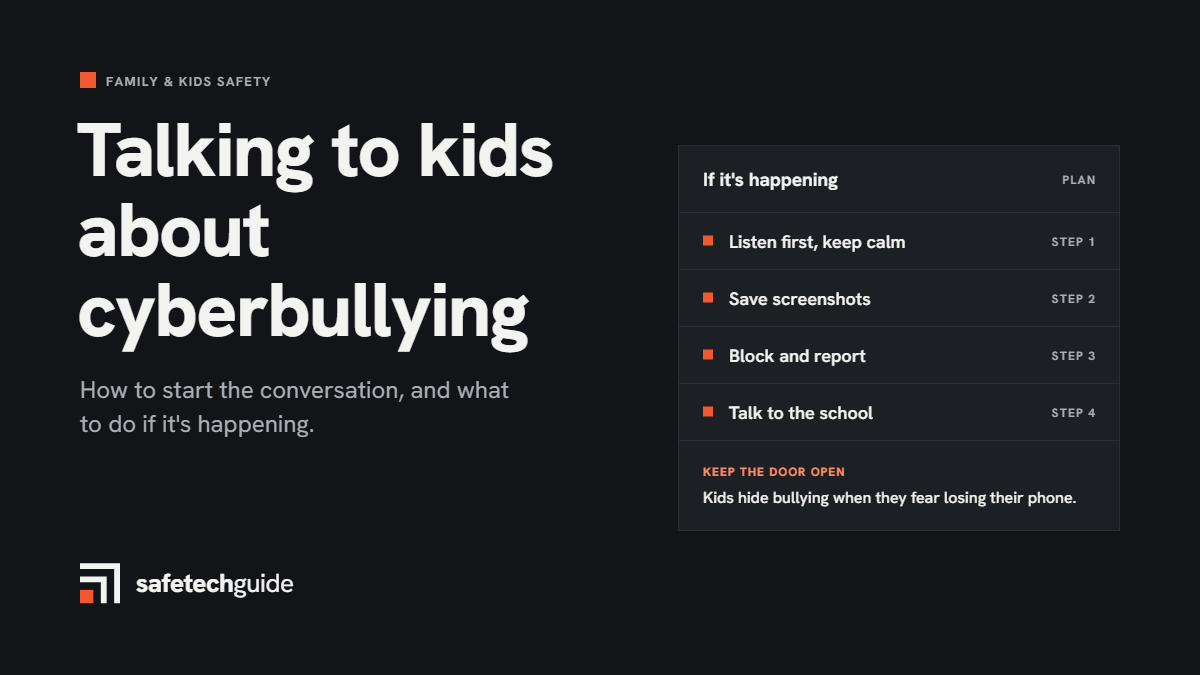

Talk early and often, listen more than you lecture, and make it clear your child won’t lose their phone for telling you. If cyberbullying happens, don’t respond to or forward the messages, instead, save screenshots and dates, block the person, and report it to the platform and the school. Call the police if it involves threats of violence, sexually explicit images, stalking, or hate crimes. If your child is in serious distress or talks about hurting themselves, get help right away, and in the U.S. you can call or text 988.
Cyberbullying follows kids home. It happens on phones, gaming platforms, tablets, and computers, often at any hour and in front of an audience. This guide covers how common it is, how to start the conversation, the warning signs, and the steps that work when it happens.
What the Data Shows
The most recent national numbers come from the Centers for Disease Control and Prevention’s 2023 Youth Risk Behavior Survey of U.S. high school students (grades 9 to 12). The CDC reports that 19% of students were bullied at school, up from 15% in 2021. Forty percent of all students, and 53% of female students, reported persistent feelings of sadness or hopelessness. Source: CDC, 2023 Youth Risk Behavior Survey Results.
A separate CDC analysis of the same survey looked at electronic bullying. Among students who used social media frequently, 17.0% were bullied electronically in the past 12 months, including 21.5% of female students and 12.2% of male students. The analysis found that frequent social media use was associated with a higher prevalence of bullying victimization at school and electronically, and with persistent sadness or hopelessness and some suicide risk. The CDC notes this is a cross-sectional study, so it cannot show that social media causes these outcomes. Source: CDC MMWR, “Frequent Social Media Use and Experiences with Bullying Victimization…” (October 2024).
These figures don’t describe your child, but they show that it is common, and that it is tied to how kids feel. That’s why the first rule is to keep the conversation open.
What Counts as Cyberbullying
StopBullying.gov, a federal resource, says cyberbullying includes any bullying that takes place over digital devices. That covers mean or threatening messages, spreading rumors, posting embarrassing photos or videos, impersonating someone with a fake account, and excluding someone from group chats. Fake images and videos made with AI can be part of it too. See our guide to AI-generated fakes.
How to Start the Conversation
- Start early and keep it casual. Talk before there’s a problem, in the car or while cooking, not in a formal sit-down. Ask what apps and games they use and who they talk to.
- Ask open questions, then listen. “Has anyone ever said something mean to you online?” “What would you do if someone did?” Don’t interrupt or jump to fixing it.
- Explain what to do. Tell them not to reply, to save the evidence, to block, and to tell you or another trusted adult.
- Promise support, not punishment. Kids often hide cyberbullying because they fear losing their phone or accounts. Say clearly that coming to you won’t cost them their device. This is our advice, not a StopBullying.gov quote, but it matches what we see from families.
- Talk about their own behavior too. Teach them to think before they post and to speak up kindly when they see someone targeted. See our parent’s guide to social media safety.
Warning Signs
StopBullying.gov lists signs that a child may be being bullied, in any setting:
- Unexplainable injuries, or lost or destroyed belongings
- Frequent headaches or stomach aches, or faking illness
- Changes in eating habits
- Difficulty sleeping or frequent nightmares
- Declining grades, loss of interest in schoolwork, or not wanting to go to school
- Sudden loss of friends or avoidance of social situations
- Feelings of helplessness or decreased self-esteem
- Self-destructive behaviors, such as running away from home, harming themselves, or talking about suicide
It also lists signs that a child may be bullying others, including getting into fights, being increasingly aggressive, frequently being sent to the principal’s office, blaming others for their problems, and not accepting responsibility. Source: StopBullying.gov, “Warning Signs for Bullying”.
Online, look for a child who suddenly seems upset after using a device, hides the screen, or avoids their devices altogether. These signs have other causes. StopBullying.gov says to talk with children who show signs of being bullied or bullying others, since talking can help identify the root of the problem.
What to Do If It Happens
StopBullying.gov’s reporting guidance, step by step:
- Don’t respond to and don’t forward the messages.
- Keep evidence. Save and print screenshots, emails, and text messages, and record dates, times, and descriptions of each incident.
- Block the person.
- Report it to the platform. Cyberbullying often violates the platform’s terms of service, and each platform has its own reporting steps.
- Report it to the school. In many states, schools must address cyberbullying under their anti-bullying policy, and some state laws also cover off-campus behavior that creates a hostile school environment. Check with your state or local education agency.
- Report to law enforcement when it involves threats of violence, sexually explicit messages or photos, taking a photo or video of someone where they would expect privacy, stalking, or hate crimes. Some states treat other forms as crimes too, so check your state’s laws.
Source: StopBullying.gov, “Report Cyberbullying”.
If the bullying involves threats, demands for money, or intimate images, see our guide to what to do if someone is blackmailing you online.
If your child is in serious distress or danger: StopBullying.gov says not to ignore it and to get help right away, and its Get Help Now page lists resources. In the U.S., you can call or text 988 to reach the Suicide & Crisis Lifeline.
Set Boundaries and Use Tools Wisely
StopBullying.gov’s parent guide suggests that you:
- Talk openly with your child about online risks.
- Review or reset your child’s phone location and privacy settings.
- Know your child’s usernames and passwords for social media and gaming platforms.
- Consider whether monitoring apps could be right for your family, noting that monitoring works best alongside open conversations.
- Limit screen time through phone settings or apps, or set “unplugged zones.”
Source: StopBullying.gov, “Parent Guide to Cyberbullying and Digital Awareness” (reviewed December 2025).
Choose tools your child knows about, and avoid secret monitoring. See our post on spyware for why covert apps are risky. For account settings, see how to secure your social media accounts, and for younger children, choosing a first smartphone and safe search for kids.
Model the Behavior You Want
Kids watch how adults talk online. Don’t mock people in comments, forward humiliating content, or post photos of your kids that they’d be embarrassed by. Say it out loud when you choose not to reply to something nasty.
If Your Child Is the One Bullying
StopBullying.gov says it is important to talk with children who show signs of bullying others. Stay calm, ask what’s going on, and make the harm clear without shaming them. Involve the school if needed and set consequences, such as limits on the account or device, that fit what happened.
People Also Ask
Don’t respond to or forward the messages, save screenshots with dates and times, and block the person. Then report it to the platform and the school, and to the police if there are threats, explicit images, stalking, or hate crimes.
StopBullying.gov doesn’t recommend it in the pages we reviewed. Our advice is that taking the device can teach kids to hide problems, so reassure your child first.
In the CDC’s 2023 survey, 17.0% of frequent social media users in high school were bullied electronically in the past 12 months, and 19% of all students were bullied at school. These are national figures for one age group.
StopBullying.gov says cyberbullying should be reported to law enforcement when it involves threats of violence, sexually explicit messages or photos, taking a photo or video where someone expects privacy, stalking, or hate crimes.
In many states schools must address cyberbullying, and some state laws cover off-campus behavior that creates a hostile school environment. Check your state or local education agency.
Keep the door open, try a calm time and place, and consider a school counselor or trusted adult. If you’re worried about their safety, get help right away.
Sources: CDC, 2023 Youth Risk Behavior Survey Results; CDC, MMWR Supplement, “Frequent Social Media Use and Experiences with Bullying Victimization, Persistent Feelings of Sadness or Hopelessness, and Suicide Risk Among High School Students — Youth Risk Behavior Survey, United States, 2023” (October 2024); StopBullying.gov (HHS), Report Cyberbullying; StopBullying.gov, Parent Guide to Cyberbullying and Digital Awareness (December 2025); StopBullying.gov, Warning Signs for Bullying (November 2021)